Elgin Theatre
Station ElevenThe Elgin Theatre is the Toronto playhouse where Arthur Leander collapses during a performance of King Lear, transforming a scene of theatrical madness into an urgent attempt to save his life. Its stage, lobby, and later appearance in the city’s snowy streets connect the public spectacle of Arthur’s final performance with Jeevan Chaudhary’s disoriented passage into the crisis beyond the theatre.
Setting and Performance
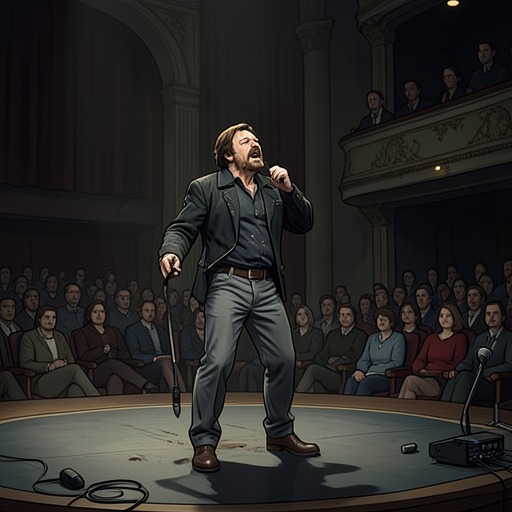
On a winter night, the theatre’s stage is arranged for Act Four of King Lear. Three girls have played a clapping game as the audience arrived; in the mad scene, they return as hallucinations, moving through the shadows as Arthur, fifty-one, reaches for them. Flowers in his hair and a pool of blue light make the scene an image of theatrical unreality even before his physical distress becomes unmistakable.
Arthur falters, strikes a column while reaching for it, and delivers a line in a wheezy voice that is barely audible. The stage snow continues to fall as the performance gives way to emergency. The theatre’s artifice does not disappear when the crisis begins: plastic snow shimmers around Arthur while the audience’s murmurs, a rising spectator, and the approach of an usher register the confusion between acting and real danger.
The Collapse and Emergency Response
Jeevan Chaudhary, seated in the orchestra section and training to be a paramedic, rises from his seat despite his girlfriend’s attempt to stop him. Once it is clear Arthur is not breathing, he begins CPR. The curtain drops, cutting the audience off from the stage and reducing its brilliance by half; the blue-white theatrical storm is replaced by fluorescent light. In this altered space, Jeevan works beside Arthur until cardiologist Walter Jacobi comes through the curtain and kneels on the other side of Arthur’s chest.
The theatre’s stage thus becomes a makeshift emergency room, with the curtain both separating the public from the response and marking the performance’s abrupt interruption. Jeevan later walks back onto the stage and out through its velvet curtains. The contrast between the emergency’s concentrated intensity and the emptied auditorium is sharp: ushers collect dropped programs, a forgotten scarf remains on a seat, and the audience has dispersed.
Lobby and Afterimage
In the red-carpeted lobby, Jeevan searches for his girlfriend, Laura, calling her and checking the ladies’ lounge and coat check. She is gone; her blue coat is no longer there. The theatre’s public rooms, recently filled with spectators, become a sequence of places where Jeevan looks for someone who has left without him. His own overcoat is among the last few remaining at the check, a small detail that underscores how quickly the crowd has emptied out.
Later, after speaking by phone with Hua, Jeevan passes the darkened theatre on Yonge Street. Posters still advertise King Lear, showing Arthur looking up into blue light with the dead Cordelia limp in his arms. The image recalls the stage snow as a taxi moves slowly through the storm outside, its headlights catching the falling snow. For a moment, the street scene carries the visual effect of the performance into the city; Jeevan shakes off the image of Arthur’s blank stare and continues toward his brother’s building.
Narrative Significance
The theatre is both the site of a literal collapse and the source of an image that recurs in Jeevan’s perception after he leaves. Its effects—blue light, falling snow, flowers, and the theatrical figure of Cordelia—blur the boundary between performance and the emergency unfolding within it. Later, the poster and the snow-lit taxi make the building a point of return in the narrative: Jeevan’s memory of the stage follows him out into Toronto, where the storm is no longer a theatrical device.